But where does A4 come from?
 Agence Puck
5 December 2024
Paper formats play a key role in the world of printing. From the large A0, ideal for plans and posters, to the practical A4, ubiquitous in offices and homes, each format is designed to suit a variety of needs. But behind this simplicity lies a rich history and an ingenious design. We explain.
The origin of A formats dates back to the 18th century. In 1786, the German physicist Georg Christoph Lichtenberg came up with a constant aspect ratio (√2:1) for sheets of paper. This concept was later formalised with the birth of the metric system in 1798, under the impetus of the French Revolution, which sought to standardise measurements in Europe.
However, it wasn't until 1922 that Walter Porstmann, a German engineer, developed the DIN 476 standard. This system laid the foundations for the formats we use today, including A4. In 1975, this standard was adopted worldwide as ISO 216.
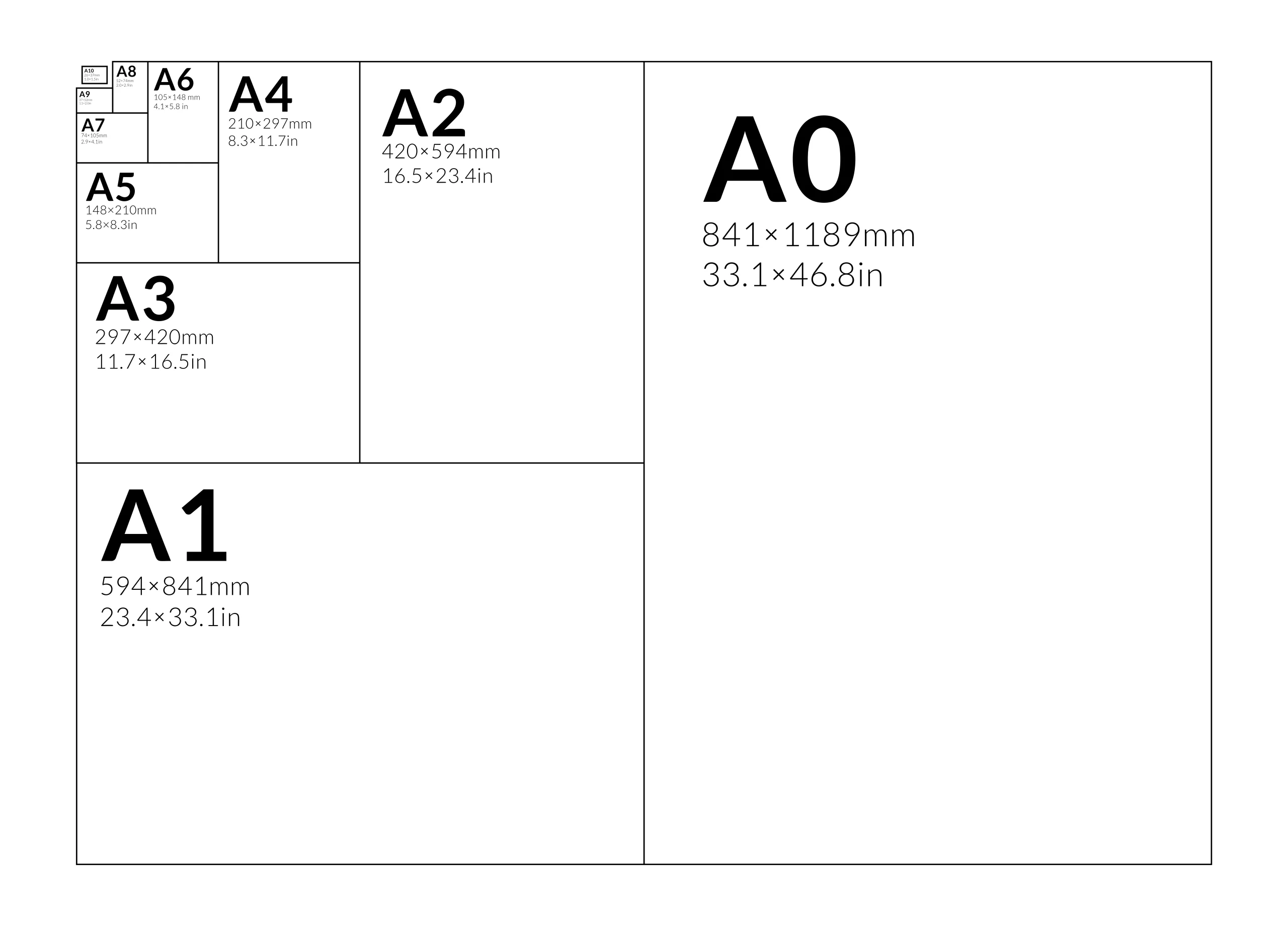
What sets A formats apart is their geometric design. A0, for example, has an area of 1 m². Folding this sheet in half along its length gives you an A1 (0.5 m²), then an A2, an A3 and finally an A4. This system of division makes it possible to reduce or enlarge formats while maintaining a constant ratio of √2:1.
This means that:
Here is an overview of the areas:
This ingenious system meets specific needs:
With its dimensions of 21 × 29.7 cm, the A4 format is indispensable. It is used for everyday printing, administrative correspondence, teaching materials and marketing documents. A0, for its part, remains the format of choice for posters and technical plans, while the intermediate formats (A1, A2, A3) are suited to specific uses. For example, an A5 can easily be used for a flyer, as with this visual created by the Agency for Chryso.
At Puck, we know that choosing the right format is essential to the success of your materials. Understanding formats enables you to design your materials better and to make the most of technical constraints to optimise your printing costs.
Would you like to find out more?
PUCK SUPPORTS SODERN (AIRBUS GROUP) INTERNATIONALLY
.elementor-3246 .elementor-element.elementor-element-5e22881d{text-align:justify;}.elementor-3246...
2025 BtoB marketing and communication: what are the prospects?
Even as tools evolve (digitalisation, AI, automation…), a number of principles remain the foundation of any...