SEA B2B: How to succeed with your Google Ads campaign to generate qualified leads?
 Agence Puck
February 5, 2026
Agence Puck
February 5, 2026
With competition becoming ever more intense in the B2B sector, Google Ads has become an essential lever for generating qualified leads and maximising a company's visibility. Unlike SEO, which takes time to deliver results, paid search (SEA) provides immediate visibility and captures prospects who are actively searching.
Key statistic: 65% of B2B companies use Google Ads to generate leads (source: HubSpot). Yet many campaigns are poorly optimised, resulting in wasted budget and a low return on investment (ROI).
So how do you structure an effective B2B Google Ads campaign? What are the key levers for attracting the right prospects, maximising your budget and optimising your conversions?
Discover the 5 essential steps to a successful SEA strategy that turns your advertising budget into a lead-generating machine.
Before diving into practical optimisations, here's why an effective SEO strategy is crucial in B2B:
Google Ads offers many advantages for B2B companies looking to attract customers quickly:
Now let's look at how to structure an effective B2B SEA campaign.
Google Ads campaigns rely on a strategic choice of keywords and campaign type.
Recommendations: analyse the most profitable keywords and adapt your strategy according to performance.
A good account structure helps optimise Google's Quality Score and improve ad performance.
Recommendations : structure your campaigns and test several ad versions to identify the ones that perform best.
A prospect who clicks on your ad must land on a page optimised for conversion.
Good budget management helps avoid unnecessary spending and maximise ROI.
Recommendation: regularly analyse your performance with Google Ads and Google Analytics to adjust your budget according to results.
5. Use remarketing to convert warm prospects
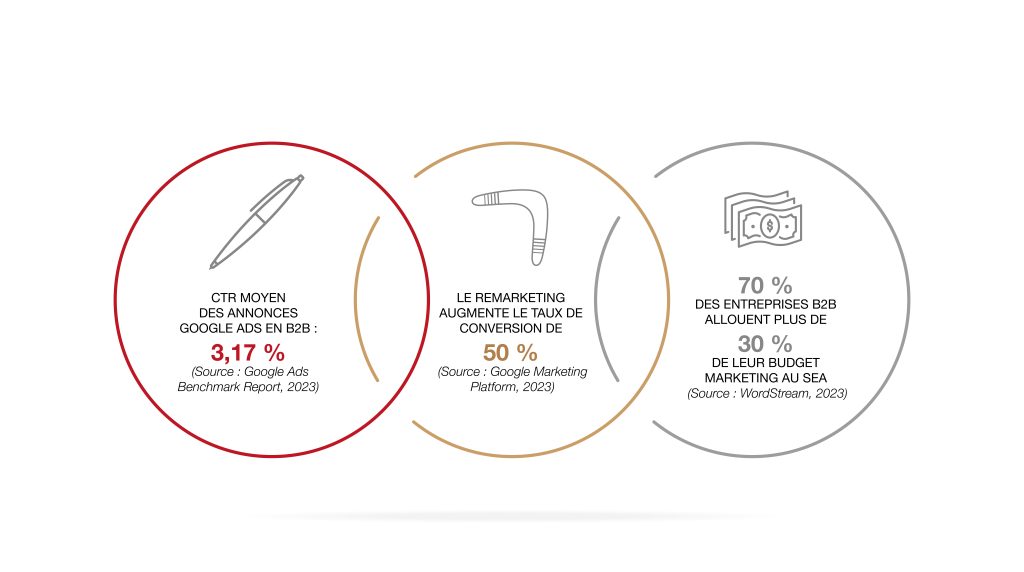
70% of visitors don't convert on their first visit. Remarketing is an effective way of re-engaging them.
Recommendation : Integrate remarketing into your strategy to re-engage prospects and maximise your conversions.
An optimised B2B Google Ads campaign rests on 5 key elements:
Need SEO support to boost your visibility?
Contact Agence Puck now for a tailor-made SEO strategy!
During economic downturns, companies look to protect their profits by cutting costs....
How to optimize your B2B LinkedIn strategy to attract customers?
Build a high-performing B2B content marketing strategy to attract prospects, strengthen your expertise and generate...