
How to build a successful B2B content marketing strategy?
 Agence Puck
24 November 2025
Today, content marketing is an essential lever in B2B. It not only attracts new customers, but also turns them into loyal ambassadors for your brand.
57% of B2B buyers make their purchasing decision before they even contact a salesperson. They look for information online, compare solutions and read content before taking action. If your company doesn't produce quality content, you risk going unnoticed compared with your competitors.
But how do you put an effective B2B content marketing strategy in place? What are the best-performing formats? How do you optimise your content for SEO?
In this article, discover the 5 essential steps for building a content strategy that attracts qualified traffic and generates leads.
1. A powerful lever for attracting and converting customers
B2B decision-makers are above all looking for solutions to their problems. Relevant, well-structured content that meets their needs is the first step towards a relationship of trust.
2. A growth engine for SEO and visibility
Content marketing is one of the pillars of organic search (SEO). A site that regularly publishes optimised content gains visibility on Google and attracts more qualified visitors.
Companies with a blog get 67% more leads than those without one.
3. A key competitive advantage
In a world where prospects' attention is increasingly in demand, a well-thought-out content marketing strategy helps you stand out and assert your expertise.
The challenge is to create engaging, SEO-optimised content adapted to your audience's needs. Let's see how.
Before producing content, you need to ask yourself the right questions:
Recommendation: create a summary document with the profiles of your personas and their expectations.
2. Choose the right content formats
B2B companies need a varied mix of content to reach their audience at different levels of the conversion funnel:
Blog articles – to attract organic traffic through SEO.
White papers & case studies – to generate qualified leads.
Videos & webinars – to boost engagement and interaction.
Infographics & LinkedIn posts – to encourage sharing and virality.
Example: HubSpot generates thousands of leads through its downloadable guides and SEO-optimised articles.
3. Set up an editorial calendar
A well-structured editorial calendar helps you publish content on a regular basis.
Steps for creating an effective calendar:
4. Optimise SEO to maximise visibility
Well-written content isn't enough: it has to be visible on Google. Here are the SEO best practices to include in your strategy:
On-page optimisation:
Technical SEO:
Recommendation: a company that optimises its articles for long-tail keywords generates more organic traffic. Remember to carry out regular SEO audits to optimise your older content.
5. Analyse performance and adjust your strategy
Good content marketing relies on continuous analysis and improvement.
KPIs to track:
Recommendation: adjust your strategy every 3 months according to results.
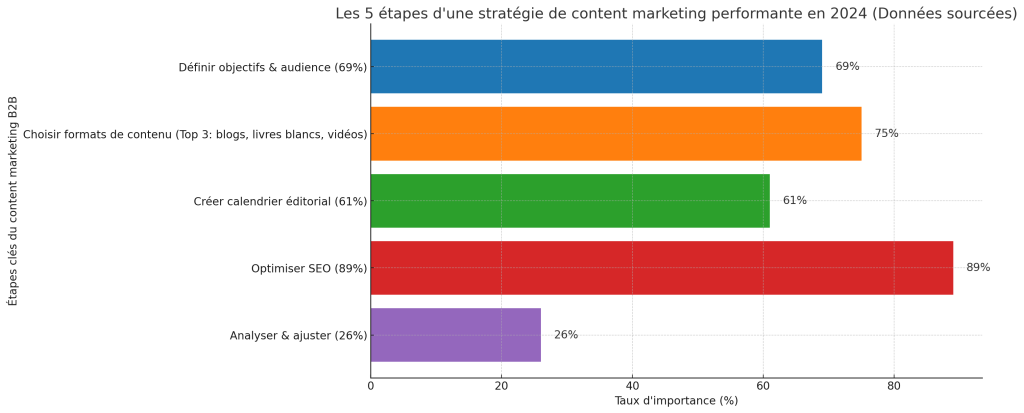
Content marketing is a key lever for B2B companies. An effective strategy rests on 5 essential elements:
Ready to boost your content marketing?
Agence Puck can help you put in place a content strategy optimised for SEO and lead generation.
Contact us now for a personalised consultation!
PUCK AND ITS VISION OF COMMUNITY MANAGEMENT
.elementor-2560 .elementor-element.elementor-element-2f8c391{text-align:justify;}.elementor-2560...
HOW TO POSITION A TERRITORY OR A TOURISM PLAYER EFFECTIVELY
As we all know, our daily lives are papered with promotional advertising messages. No fewer than 3,000...


Comment (01)